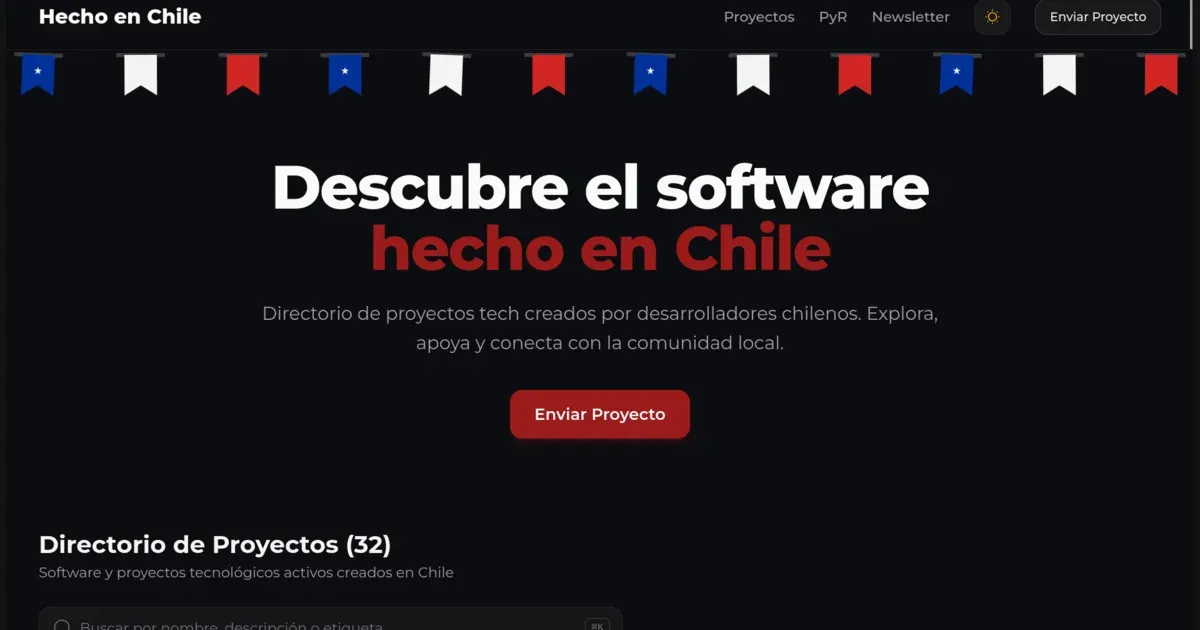
In one sentence: Made in Chile turns scattered local launches into a searchable place where people can discover who is building what—and visit the actual product.
Why I built it
Chilean developers regularly launch useful tools, SaaS products, libraries, and experiments. Most are shared once on a personal account and then disappear into the timeline.
Global platforms help mature products distribute worldwide, but they are not designed to answer a local question:
What software is being built by people in Chile right now?
Made in Chile is my attempt to answer it with more context than a spreadsheet and less noise than a social feed.
The product loop
The directory has four core actions:
- a visitor searches or filters projects;
- they open a dedicated project page;
- they continue to the creator’s product;
- a builder submits another project to the catalogue.
Everything else should strengthen that loop. Features that do not improve discovery, trust, or submission quality are secondary.
What I designed and built
I own the product design and implementation, including:
- the project taxonomy and submission model;
- server-rendered pages in Astro;
- React islands for search, filters, forms, and interactive cards;
- Supabase persistence and access policies;
- project detail pages and share actions;
- image processing and fallbacks;
- likes with optimistic feedback;
- sitemap, structured metadata,
llms.txt, and social previews; - unit and Playwright end-to-end test foundations.
Search should survive a copied URL
Filters are useful only if visitors can share what they found. The search state is synchronized with URL parameters, so a filtered view can be bookmarked, copied, and revisited instead of existing only inside React state.
A keyboard shortcut opens search for desktop users, while touch interactions remain explicit on mobile. This is a small example of the product principle I use throughout the site: speed for frequent users must not hide the path from first-time users.
Server-rendered foundation, interactive edges
The catalogue and detail pages benefit from server rendering: projects are indexable, links have meaningful metadata, and initial content does not wait for a client bundle.
React is reserved for interactions that need immediate feedback:
- search and category filters;
- submission validation;
- likes;
- project actions;
- newsletter and modal flows.
This avoids treating the whole directory as a single-page application just because some cards are interactive.
Trust is the real data model
A community directory becomes useless if entries are stale, misleading, or impossible to verify. The submission form therefore needs more than a name and a URL. A project should communicate:
- the problem it solves;
- its current stage;
- who created it;
- how to try it;
- which category actually describes it.
Zod validates the form shape, but technical validation is only the first layer. Editorial review still matters. A valid URL can point to a weak or deceptive submission.
A visual identity people can place
The interface uses Chilean red, blue, and white without turning every surface into a flag. A row of small pennants creates a recognizable local rhythm; the rest of the UI stays dark, quiet, and focused on projects.
The goal was not to make a government portal or a patriotic campaign. It was to make a technology product that clearly belongs to a place.
Local identity works best as a shared coordinate, not as decoration pasted onto the product.
What launching taught me
I initially spent too much effort on platform completeness: reactions, featured placements, submission states, and visual polish. The constraint was not missing software. It was catalogue quality.
A directory with fewer projects and strong profiles is more useful than a large import of unexplained links. That changed the roadmap toward:
- improving project descriptions;
- making acceptance criteria visible;
- checking stale links;
- highlighting lessons and builders, not only logos;
- measuring outbound discovery rather than vanity traffic.
Current limitations
- Moderation still depends heavily on manual judgment.
- Categories will need revision as the catalogue grows.
- Likes indicate interest, not project quality.
- The platform needs a clear policy for inactive or abandoned entries.
- I have not yet demonstrated that featured placement produces useful outcomes for creators.
- Community governance is still more aspiration than implemented process.
Next steps
- Publish transparent submission and moderation guidelines.
- Add freshness checks and let creators update their own entries safely.
- Measure successful outbound visits while preserving visitor privacy.
- Interview listed builders about whether the directory produced useful contact.
- Build editorial collections around problems—education, public services, developer tools—not only categories.
Stack
- Framework: Astro 7 with server rendering
- Interactive UI: React 19
- Data: Supabase
- Validation: Zod and React Hook Form
- Styling: Tailwind CSS 4
- Testing: Vitest and Playwright
- Deployment: Vercel